
Published: July 2, 2026
Publication: CalMatters
Author: Brittany Oceguera

For Tré Willingham, pursuing a doctorate degree at UC Irvine has felt isolating at times. Often the only Black student in his science classes, he recalls being the last one to be chosen when activities required a lab partner. He also has never had a Black professor.

“It’s very disheartening to never see anyone that looks like you,” said Willingham, who studies applied physics. “It makes it hard to believe that you can get there, and especially get there and actually be yourself.”

For Willingham and students like him, the state-funded Cal-Bridge program is helping them pursue their dreams of landing a doctorate in the sciences and joining the next generation of STEM professors. The program provides financial support, research opportunities and diverse mentors of similar backgrounds.

Such mentors make “it much easier to start to navigate these spaces and also believe that you can get to the other end,” Willingham said.

Cal-Bridge was founded in 2014 to help undergraduates at Cal State campuses pursue a doctorate in STEM in partnership with the University of California, helping to close the diversity gap in science fields. About 70% of the program’s 406 students have been admitted to doctorate programs. Three quarters of the program’s students are of color, almost half are women, and nearly two-thirds are first generation.

Studies have noted that the climate of STEM higher education programs is often unwelcoming for some minority populations. Women make up over half of the undergraduate student population at Cal State campuses, yet account for only 36% of the system’s STEM students. At UC campuses, only 24% of STEM undergraduates are Latino or Hispanic, 4% are African American and 1% are American Indian.

From Cal-Bridge’s first cohort of five undergraduate students, the program has grown to support about 60 each year. It has expanded from astronomy and physics to now include computer science and math. Students in the program can receive stipends, tuition assistance, mentorship and professional development.

But the journey to diversifying the STEM teaching field is very long.
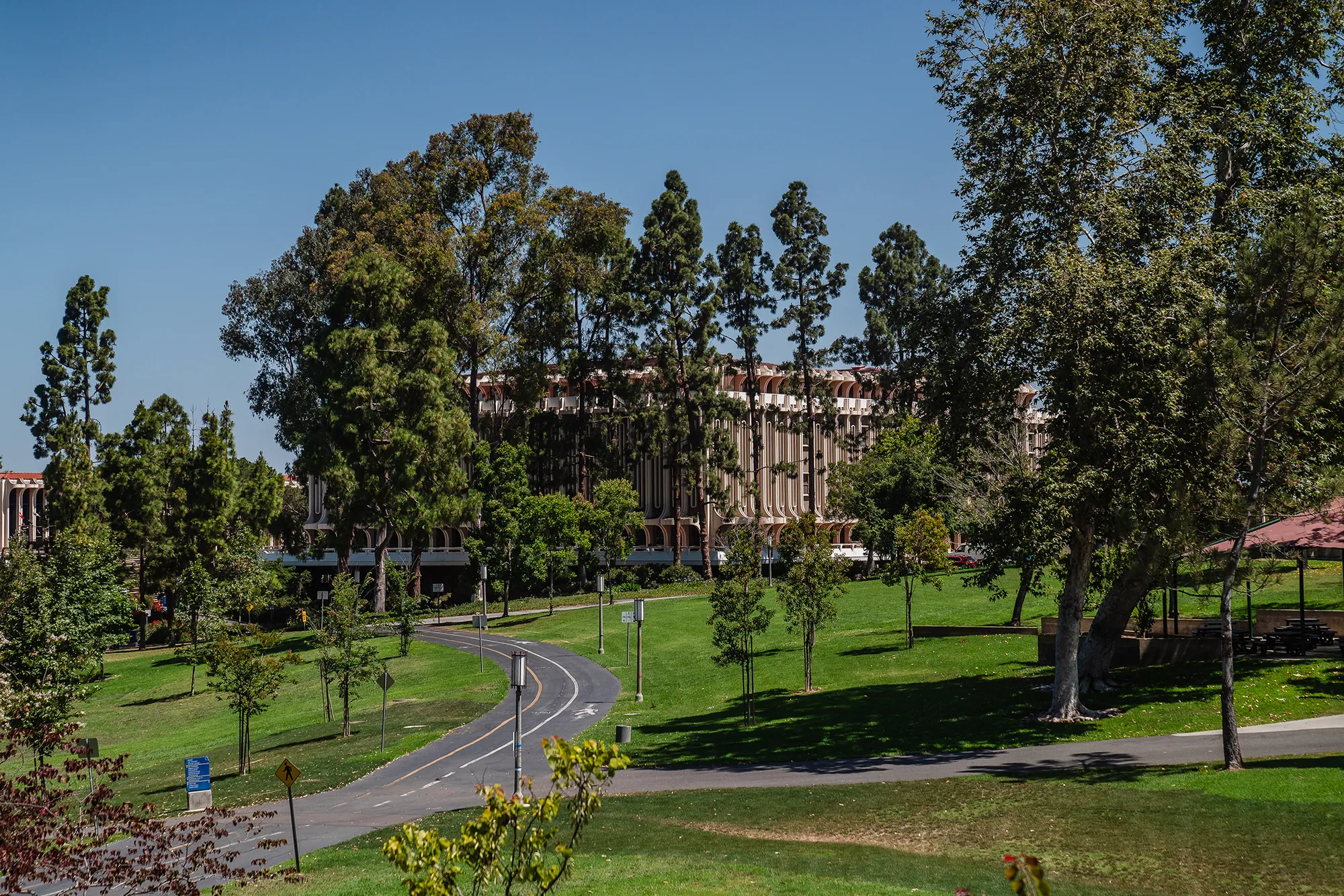
The University of California, Irvine, on June 15, 2026. Photo by Ariana Drehsler for CalMatters

So far, 15 Cal-Bridge participants have earned a doctorate. It takes students about eight years after joining Cal-Bridge, usually done during their junior year, to complete a doctorate — two years as an undergraduate and six years to complete their doctorate education.

“It’s only been 12 years since we started, so only this small group is getting their Ph.D. right now,” said Dr. Alexander Rudolph, Cal-Bridge’s executive director and founder. “But eventually we expect there to be more like 30 to 40 to 50 a year getting their Ph.Ds.”

The state Legislature has given $14 million over recent years to the program, which also has a sliver left over from an older National Science Foundation grant.

The program might also get a helpful boost in the Legislature as California pushes back against federal efforts targeting university equity initiatives.

Democratic Assemblymember David Alvarez of Chula Vista introduced Assembly Bill 2660 in April to codify Cal-Bridge as a coordinated partnership between community colleges, Cal State universities and University of California campuses. Rudolph hopes that will help secure annual or multi-year funding for Cal-Bridge in lieu of making requests each year.

Alvarez told CalMatters that as the federal administration cut back on student loans and grants for Hispanic-Serving Institutions, California should do more to support its students.

“The lack of representation from first-generation students in the Ph.D. level of education speaks for itself,” said Alvarez. “We need to do something in California to demonstrate that we still believe that we have strength in diversity of our Ph.Ds, of our academia, and this (Assembly bill) is one way to try.”

Financial assistance allows students to prioritize academics

Willingham, the UC Irvine student, hadn’t considered pursuing a doctorate earlier in his life. Now 31, the first-generation scholar is pursuing his doctorate with the goal of one day becoming a professor.

“No one around me was a doctor of anything,” said Willingham about his family and friends growing up.

Willingham grew up in Littleton, Colorado where he attended Columbine High School. After high school, his father, who had served in the Air Force, and Willingham moved to Atlanta. In 2017, he moved to California where he began his higher education journey. He is now the father of two children, ages 12 and two, balancing family time with his studies.

Today, Willingham’s research focuses on creating new quantum materials and exploring how they could be used in future sensors and electronic devices.
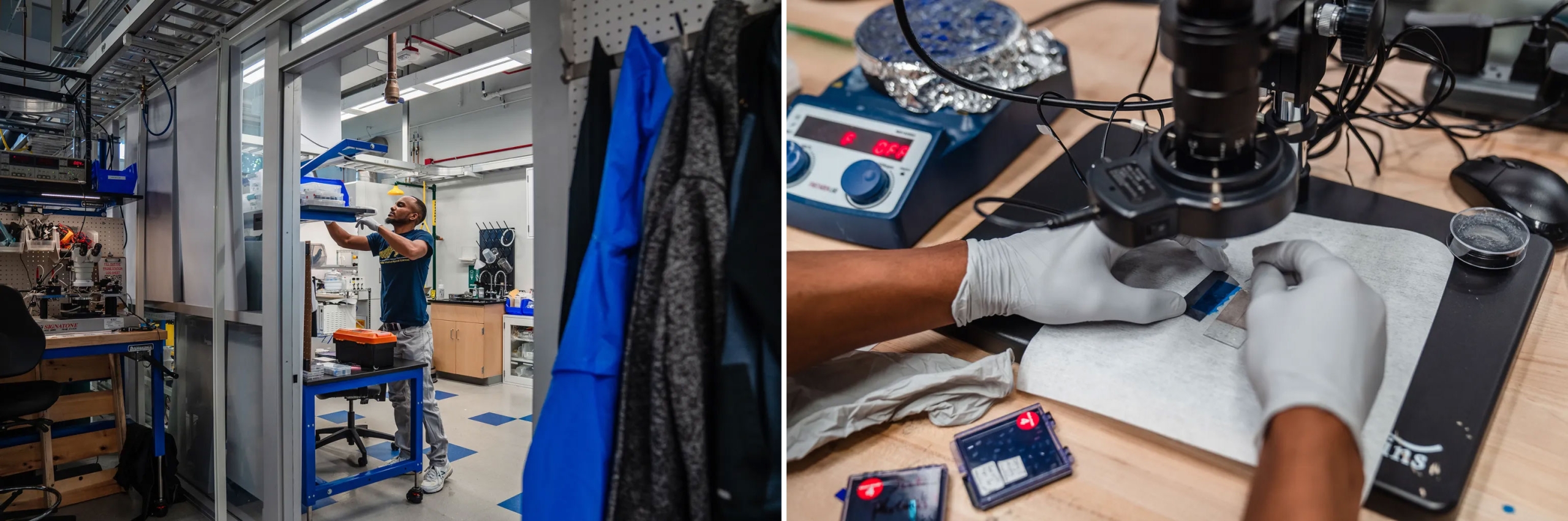
Tré Willingham works inside a lab in Rowland Hall at UC Irvine on June 15, 2026. Photos by Ariana Drehsler for CalMatters

Cal-Bridge has four programs: undergraduate, summer research, doctoral and postdoctoral. The undergraduate program is open to STEM students at Cal State campuses and community college students who plan to transfer to a Cal State. It receives up to 100 applications per year; about 60 students were accepted this past year.

Willingham attended El Camino College and Compton College simultaneously to finish his associate degree quickly, then joined Cal-Bridge’s undergraduate program after transferring to Cal Poly Pomona. There, the program gave him $10,000 during each of his junior and senior years, which helped him get a car to commute to school from Los Angeles and stay focused by working fewer hours as a tutor.

“I was able to just sort of focus my attention a little better, not having to always think about how I’m going to pay the next bill,” said Willingham.

Later in Cal-Bridge’s doctoral program, Willingham received $40,000 in financial support for his first year of graduate school at UC Irvine. He used $16,000 to pay his tuition and the rest for living expenses.

Mentorship helps students find their place in STEM

It took Dr. Katy Rodriguez Wimberly, a Cal-Bridge alum, 13 years to become a research faculty member. She is now an astrophysics assistant professor at Cal State San Bernardino.

Wimberly researches near-field cosmology, studying neighboring galaxies that may be some of the first ever formed.

“It’s almost like galactic archaeology, like I’m looking at these little almost-fossil galaxies to learn more about the early universe and where everything came from,” said Wimberly.

She is also now the director of mentorship for Cal-Bridge. During her junior year as an undergraduate, she joined Cal-Bridge’s first cohort, helping her imagine what being an astronomer would be like.

The mentors and the program’s monthly workshops showed her that while she didn’t see many Latina women like her teaching STEM on her campus, she could do it. When she was an undergraduate at Cal State Long Beach, she said, there were only two women professors from about 20 faculty in her department, and none of them Black or Latino.

Cal-Bridge provided Latino mentors she wasn’t finding anywhere else.

“It wasn’t like they were teaching me in a classroom, but they did kind of provide that cultural and kind of identity support,” said Wimberly.

Wimberly had applied to 11 doctorate programs as a senior undergraduate and was denied by all of them. Next, she applied and was accepted to Cal State Long Beach to pursue a master’s in physics. There, she raised her GPA, reapplied to doctorate programs and was accepted to UC Irvine. She graduated in 2021 with her doctorate in physics.

At UC Irvine, Wimberly created a peer mentorship program for Cal-Bridge students as a way for alumni and graduate students of the program to support the undergraduate students. Mentors and mentees meet in small groups once a month, as well as have one-on-one meetings.

“I structured it in a way to be more like, this is just your older cousin that’s telling you how to get through things,” Wimberly said.

After she finished her doctorate, she had a three-year, full-time fellowship with the National Science Foundation. She served at UC Riverside with her former mentor, Laura Sales, an astronomer from Argentina and associate professor at the university.

Learning from Sales made her feel more comfortable embracing her identity as a Latina. Sales taught her that she didn’t have to be an expert in all areas of astronomy, but that she would work alongside experts in different areas.

Now as a professor herself for the last three years at Cal State San Bernardino, Wimberly offers the same mentorship to her students. Anytime she sees a Latina student who doesn’t have support from someone with a similar background, she tries to provide that support.

“Just because I know it can be so difficult,” said Wimberly.

Claire Rogers, a student at UC Irvine pursuing a doctorate in physics, knew she wanted to attend graduate school, but she didn’t realize how isolating the experience would be as the only woman in the room. She is a Cal-Bridge doctorate scholar researching observational astrophysics, looking for planets outside of the solar system to determine if there is life on those planets. She also focuses on how stellar astrophysics affects measurements when looking for planets.
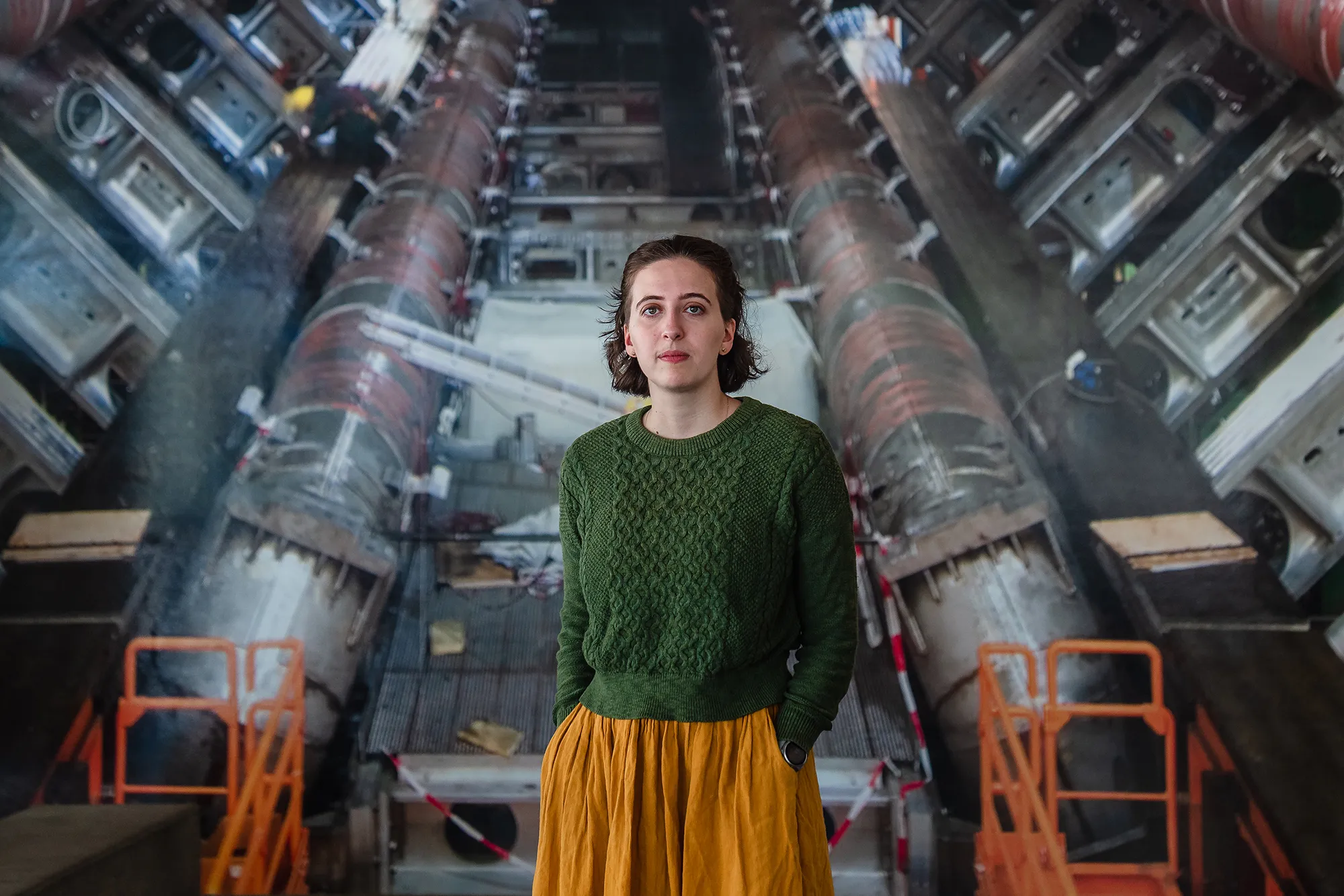
Claire Rogers, a Cal-Bridge doctorate scholar, at Frederick Reines Hall at UC Irvine, on June 15, 2026. Rogers is pursuing a Ph.D. in physics. Photo by Ariana Drehsler for CalMatters

Rogers was an undergraduate at Cal Poly Humboldt and joined Cal-Bridge during the first year the program expanded to her campus.

“Cal-Bridge was really helpful for providing a network of students at the same phase of their career at different CSU campuses but still working towards similar goals,” said Rogers.

She said that since the department on her campus was small, Cal-Bridge allowed her to connect with students at other campuses who were in similar positions.

The program provided her two mentors, a professor at her campus and a professor at UC Berkeley. The program also offered her guidance in applying for graduate school.

“I’m sure it made a huge difference in my grad school essays, getting that feedback,” Rogers said.

Rogers participated in an undergraduate summer research program at the University of Wyoming through Cal-Bridge, where she dabbled in astrophysics research for the first time. Cal-Bridge’s summer program is open to community college and Cal State undergraduate students and allows students to participate in research projects at partner institutions. Out of around 200 applications, only 50 to 60 students get accepted to the summer program.

“I really like spending time at a telescope … and dealing with all of the problems that come up when you are running a telescope overnight,” she said.

She was usually the only woman in her undergraduate classes, and in graduate school there were only three women in her cohort of 22 students.

“I got very accustomed to being the only woman in a room,” said Rogers.

She mentioned feeling isolated during her first year at UC Irvine, noticing that her classmates rarely showed up when she organized study groups and that the men in her lab would change the conversation when she entered the room.

“I had a really hard time my first year with reconciling that I felt very unwelcome,” said Rogers.

She eventually found a support network outside of her original cohort, getting closer to other doctoral scholars in Cal-Bridge and having monthly movie nights together.

“Cal-Bridge has made a huge difference to my career and my, sort of, finding my space in this field,” said Rogers.

Rogers hopes to one day become a professor and be able to teach while continuing her research in observational astrophysics.

“When I was new to physics it made a big difference for me to have women professors,” said Rogers. “I think it’s important for future students to also have that resource and that support, and I would like to be able to provide that.”

Brittany Oceguera is a contributor with the College Journalism Network, a collaboration between CalMatters and student journalists from across California. CalMatters higher education coverage is supported by a grant from the College Futures Foundation.
Published: June 22, 2026
Publication: Haverford Magazine
Author: Sari Harrar

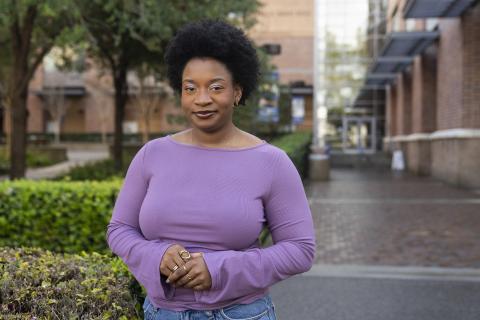
Tré Willingham, a Ph.D. student at the University of California, Irvine, builds one-atom-thick structures to observe the mysterious behavior of electrons. In 2025, he won a prestigious National Science Foundation (NSF) Graduate Research Fellowship to support his work. “The award gives me the freedom to conduct bold, high-impact quantum materials research,” he says.

But just a few years ago, advancing in science looked like a rocky climb despite Willingham’s passion and persistence.

“I was in a tough situation,” he says. While in community college, he experienced homelessness, sometimes sleeping in his car and skipping meals when money was tight. He and his partner were raising a daughter, and by 2024, expecting the birth of their son. When his car blew a gasket, he commuted 2.5 hours each way by bus to junior- and senior-year classes at California State Polytechnic University (Cal Poly Pomona). During these years, Willingham was chief engineer for a club at Compton College (a Los Angeles-area community college) that built a functioning rocket from surplus aerospace parts, became captivated by the “elegance and beauty” of applied mathematics, and was a busy math and science tutor.

“I was ambitious,” he says. “I wanted a career in physics but didn’t know how to pursue it.” Then a friend — Cal-Bridge scholar Evan Haze Nuñez-Cravin, now a post-doctoral fellow in astrophysics at the University of California, Los Angeles — suggested Willingham apply to the Cal-Bridge program. Founded by Alexander Rudolph ’82, the innovative program prepares undergraduates from historically underrepresented groups to be competitive candidates for Ph.D. programs in science, engineering, and math within the University of California system and elsewhere, then supports them through earning Ph.D.s and beyond.

“I think that anyone who takes advantage of Cal-Bridge can achieve their dreams,” Willingham says. “Anything can happen.”

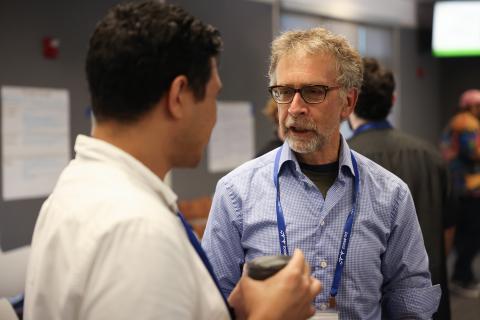
Bruce Schumm ’81, a professor of physics at University of California, Santa Cruz, and the director of Cal-Bridge’s Doctoral Program, at a summer research program in 2025. Photo courtesy of Cal-Bridge Program.

Building STEM Diversity
A professor of physics and astronomy at Cal Poly Pomona, Rudolph studies star formation and the structure of galaxies. His interest in promoting diversity in academics dates back to his upbringing and his time at Haverford.

“Growing up in the diverse neighborhood of Hyde Park in Chicago, I was instilled with a social justice mindset,” he says. “One of the attractions of Haverford College for me was the Quaker history and similar focus on social justice.” While at Haverford, he participated in a program called Eighth Dimension (now the Marilou Allen Office of Service and Community Collaboration) where he tutored a diverse group of Philadelphia elementary school students in math.

Rudolph says the glaring lack of underrepresented minority and female students in science, technology, engineering, and math (STEM) fields became even more obvious when he began teaching in California’s public higher education system. In a state where no racial or ethnic group is the majority and women outnumber men, STEM undergrad majors were predominantly white men. As a result, few grad students, professors, and people moving into skilled tech jobs were Black, Latino, Indigenous American, or women.

“It’s a long-standing, well-known issue that science in general, and the physical sciences in particular, are just not diverse at all,” Rudolph says.

The numbers are stark. Across the U.S., just 2,664 Black candidates, 2,817 Hispanic candidates, 106 Native American candidates, and 40 Pacific Islander candidates were awarded doctoral degrees in STEM fields in 2021 compared to 19,409 white candidates, according to a 2023 NSF report. In California, women and people of color start college as STEM majors as often as white men do, but 70% leave those majors by junior year — “in large part due to a lack of faculty that look like them,” according to Cal-Bridge. Classrooms with few professors or fellow students from underrepresented groups can impose negative stereotypes about intellect and academic performance, boost anxiety, sap confidence, and hasten the flight from STEM, says a 2024 University of California, Irvine paper in the Journal for STEM Education Research. Just 15% of the 1.5 million workers in the state’s burgeoning tech industry are Black or Hispanic, and just 26% are women, the group says.

With few advancing to teaching, research, and leadership roles, the optics for undergraduates in these groups are not encouraging, Rudolph says. “When there aren’t many or any people like you, you wonder whether you’re welcome and whether you can make it,” he says. “Then there’s what we call the ‘hidden curriculum.’ Plenty of students from underrepresented groups are the first generation in their families to go to college. They may have plenty of support, but they lack practical knowledge about how you go from undergraduate degrees to graduate programs. There have been various decades-long efforts to address this inequality, with not a whole lot of progress.”

Bridge to the Future 
In 2009, Rudolph used an NSF grant to send a group of Cal Poly Pomona undergrads to a summer research program at the University of Arizona. “Summer research is critical for going on to graduate school,” he notes. Students learn how to do research, find out whether they like doing it, and get a sense of where they’d like to focus. “There were many summer research programs out there, but not a lot that were really catering specifically to diverse populations,” he says.

The program grew over the next few years to include more schools. “Then, after about four years, somebody asked me, ‘So what happens after that? How do they get into grad school?'” Rudolph recalls.

The question prompted him to look at existing bridge programs around the U.S. that support underrepresented students preparing for STEM Ph.D. programs. These include summer research opportunities for undergraduates, seminars, and faculty mentoring as well as support for grad school applications (like advice on coursework, research, and grad school application essays). Some created pathways between institutions — like the successful, 22-year-old Fisk-Vanderbilt Master’s-to-Ph.D. Bridge Program that brings promising students into STEM master’s programs at Fisk University (one of the nation’s first historically Black colleges and universities), after which they apply to Vanderbilt University’s Ph.D. programs. Bridges have been around since the 1990s or even earlier; they aim to increase diversity in graduate programs not only in STEM fields but also in the social sciences and humanities.

With faculty colleagues, Rudolph came up with a plan that melded best practices from the most successful programs. “We picked the last two undergraduate years as the target, thinking that’s when students really start thinking about what comes next,” he says. “We put together a package of support — summer research, intensive mentoring, professional development workshops, and financial aid — and got an NSF grant.” Thus, Cal-Bridge was born.

The program now provides up to $15,000 (up from $10,000) in annual financial support to undergrads and, in recent years, a $40,000 fellowship award to Cal-Bridge undergraduates who go on to become Ph.D. students at University of California schools. (Scholars who choose private or out-of-state Ph.D. programs don’t get this last perk.) Participants stay in the program for up to nine or 10 years: two years as undergrads, typically five to six years as doctoral students earning a Ph.D., and then some move into Cal-Bridge-associated post-doc programs. It’s an important and intentional differentiator compared to other programs that intervene for a shorter period of time.

The need was clear. You don’t have to look at numbers to see that across the University of California system, campuses and STEM majors don’t reflect our state’s diverse population. – Bruce Schumm ’81

In 2014, Cal-Bridge’s first cohort of scholars began its journey. The program is for undergraduates enrolled in the California State University (CSU) system, one of the three levels of the California higher education system. Many start out in the state’s network of community colleges, as Willingham did. “California is uniquely well-positioned to have a program like this,” Rudolph says. “We have 116 community colleges, 23 California state universities, and 10 University of California campuses, and we have a large and very diverse student population.”

Rudolph visited campuses across California to promote Cal-Bridge. On a trip to Northern California he reconnected with Bruce Schumm ’81, a physics professor at the University of California, Santa Cruz. Rudolph and Schumm were friends at Haverford and later at the University of Chicago, where they both earned their Ph.D.s. The timing was perfect. Schumm and other faculty at University of California, Santa Cruz had been discussing ways to support STEM diversity.

“The need was clear,” says Schumm, now director of the Cal-Bridge Doctoral Program. “You don’t have to look at numbers to see that across the University of California system, campuses and STEM majors don’t reflect our state’s diverse population. When Alex came up here, there was a network ready to provide coherent and rigorous support for scholars from backgrounds not traditionally represented in higher education.”

From Disneyland to the Stars 
Among the first Cal-Bridge scholars was Katy Rodriguez Wimberly. Now an assistant professor of physics and astronomy at California State University, San Bernardino, Wimberly got her Ph.D. at University of California, Irvine, where she focused on ultra-faint dwarf galaxies, tiny, old relics from the beginnings of the universe. She’d loved math in high school, but pursued acting and music in community college and afterward, playing saxophone in an Army Reserve band and entertaining visitors at Disneyland. “In my mid-20s I was binge-watching Star Trek: Voyager shows on DVD when I realized astronomy could be a real job,” she says. “I applied to California State University, Long Beach, to finish my undergraduate degree. I had to apply several times and take more community college courses to get in.”

Wimberly realized she enjoyed research and outreach. “I didn’t have the steps all chiseled out, but I knew I wanted to be a professor,” she says. “My academic advisor told me about Cal-Bridge. I was 29, almost 30 years old.”

Like all Cal-Bridge scholars, Wimberly had two mentors as an undergraduate, one from her own school and one from a University of California doctoral program. She met with them about every two weeks. “My mentor from CSU Long Beach helped more with academics: what classes to take, how to understand the content at a more fundamental level,” says Wimberly, who now oversees Cal-Bridge’s more than 300 mentors (including herself) as director of the Cal-Bridge mentoring program. “My UC Irvine mentor helped more with ideas about my future. They both helped me get ready to apply to doctoral programs. I didn’t get into a grad program the first time I applied. My mentors were very encouraging. You see the reality of their paths. It’s easy to imagine that a university professor had a bright, shiny, smooth route to their job. My mentors would tell me about the times they tripped up and the times they struggled.”

Gabrielle Kaitlyn Lake, a computer science Ph.D. candidate at University of California, Irvine, has benefitted from Cal-Bridge’s support system. Photo by Lauren Justice.

Uniquely Successful 
Even among Cal-Bridge’s many success stories, Wimberly and Willingham stand out. In 2023, Wimberly became a tenure-track faculty member at CSU San Bernardino, one of two Cal-Bridge scholars in the program long enough to reach this goal — and, Rudolph and Schumm say, an illustration of the benefits of the program’s ongoing support. Willingham is one of 18 Cal-Bridge scholars awarded selective NSF Graduate Research Fellowships. He hopes to establish a laboratory in the future to further study quantum materials. His Ph.D. fellowship enabled him to focus on research and classwork in his first year of grad school. He says he hopes the NSF award “shows what’s possible and encourages more young Black men to imagine themselves as future scientists.”

In the past 12 years, 406 students have participated in Cal-Bridge. From the initial five-scholar Cal-Bridge cohort in 2014, the program has grown to induct about 60 new scholars per year. Over 90% complete their undergraduate degrees, and so far, 174 have entered Ph.D. programs. About 70% who apply to Ph.D. programs are accepted on the first try. Fifteen have their Ph.D.s and are now in tech jobs, teach, or have moved into post-doctoral research.

It’s a diverse group in every sense. Two-thirds of Cal-Bridge participants are students of color, 45% are women, 23% are LGBTQIA+, and 21% are people with disabilities. Sixty percent are first-generation college students. Rudolph and Schumm say Cal-Bridge stands out among bridge programs because of its size, high rate of progression into grad programs, and ongoing support that actually extends into scholars’ professional lives through summer meetings, networking, and continuing attention from mentors.

“Cal-Bridge engages these students early enough in their career that they have many, many years of encouragement and support,” Schumm notes. It’s also grown a community of participants who support each other and are the foundation of a lifelong professional and friendship network.

“It’s one of the most successful programs I know of,” says Gibor Basri, professor emeritus of astronomy and founding vice chancellor for equity and inclusion at University of California, Berkeley. “The program spans nine or 10 years from undergraduate through Ph.D. and post-doctoral research. Most others operate at one point in a student’s career and hope they’ll find support later on. But the main thing is the intense mentoring.”

Basri, who’s been a Cal-Bridge mentor, says it’s “qualitatively different” from other mentoring and bridge programs. “We see students frequently. You hear what’s going on in their life, not just in class. We can address all kinds of barriers to success that normal mentoring doesn’t catch, like a sick parent who needs help, a lost financial aid form,” Basri says. “Mentors may also have their students in class. We see how they’re performing. We don’t beat them up over grades or homework. We work on solutions.”

The approach, he says, is especially important in a time of cuts in research funding and closures of academic DEI programs. “I’ve seen diversity in STEM programs expanding the way we think about education, training, the culture of a department,” Basri says. “It’s important for students to see people like themselves in leadership roles. I don’t know that there’s a Black perspective on stellar magnetic fields, but diversity and a variety of views are always a good thing.”

Roberto Tejada Arevalo, a Ph.D. candidate at Princeton University, says Cal-Bridge’s support during his undergraduate years at CSU Los Angeles allowed him to work fewer hours at his outside jobs — including as a guide at the Griffith Observatory in Los Angeles — and focus more on classes. “My mentors kept me on track and organized to apply to grad schools,” he says. Tejada Arevalo expects to receive his Ph.D. this spring and will become a joint Cal-Bridge/University of California President’s Postdoctoral Fellow at University of California, Santa Cruz pursuing his research characterizing the interiors of gas giant planets.

In addition to summer research, he says getting to know other Cal-Bridge scholars who were in doctoral programs was important. “You’re not alone doing this,” he says. “Guidance from other scholars and my mentors made a big difference. Someone from an underrepresented minority group background may want to go to grad school and continue in science or engineering or math, but they need to figure out the academic pathway, and it’s not easy on your own.”

According to Keivan Stassun, Stevenson Professor of Physics and Astronomy at Vanderbilt University and founding director of the acclaimed Fisk-Vanderbilt Master’s-to-Ph.D. Bridge Program, Cal-Bridge works because “the program has always had a structure that is grounded in research, evidence, and best practice, for example, by incorporating successful elements from other model programs.”

Stassun notes that bridge programs can bring “the missing millions” of Americans into the nation’s STEM talent pathway. “For our nation to remain in a global leadership role for science and technology, we will need to more fully draw upon the best and brightest across all of American society, backgrounds, walks of life, and perspectives,” he says.

In the case of Gabrielle Kaitlyn Lake, a Ph.D. student in computer science at University of California, Irvine, Cal-Bridge has inspired her to support diversity and inclusion wherever she can. “As an undergrad, I was one of just two Black women in my computer science classes,” she remembers. “Now I’m a teaching assistant and hopefully someday will be a professor. I try to build community by being available to the students, by making sure everyone understands the material whether they’re a computer science major or not.” And she sees the value of diversity in her current work developing security features for computer screen readers used by people with low vision and blindness. “You can’t just use the experiences of one group of people and apply them to everyone,” she says. “The best solutions will come from the experiences of a wide variety of users.”

Cal-Bridge outgrew NSF funding (“after a while, the NSF wants to see stakeholders supporting programs,” Rudolph says) and now relies on appropriations from California’s state legislature. “We received about $11.5 million from the NSF over our first 10 years,” Rudolph says. “Now, we’ve gotten $14 million in state funding over the past four years. We have support in the legislature. We hope it continues and grows.” Funding increases, he says, would allow the program to expand into more STEM disciplines and produce up to 250 Ph.D.s a year. “Cal-Bridge has tremendous potential,” he says. “It could really transform higher education and the tech workforce.”

Contact Us